Table Of Content
- If you have any question or you want to talk about your project
- The Four Components of a Typical Hardware Prototype
- Data Leak Challenges and Data Breach in the Digital Age for Tech Leaders
- Hardware Development Guide — The Design Phase
- Hardware Engineer Education and Experience
- Code Generation for Hardware Design
- Tools and Programs Hardware Engineers Use

A normal hardware design process could take months before it comes to fruition, and any changes or modifications are not likely to be solved overnight. A hardware designer has to overcome a ton of challenges to execute a design properly. Let’s look at some of the design challenges before we explore the best design practices to adopt so that you don’t face a downside during the implementation stage.
Alternate qubit design does error correction in hardware - Ars Technica
Alternate qubit design does error correction in hardware.
Posted: Fri, 09 Feb 2024 08:00:00 GMT [source]
If you have any question or you want to talk about your project
And you have at least 5 best counties to outsource your hardware development. During the scale up to mass manufacturing you will often begin to optimize for things like manufacturability, testability, and per unit cost. These tasks will help to improve your yield and margins at volume.
The Four Components of a Typical Hardware Prototype
Because compiling hardware costs money (and takes time) it's important to check your design and make sure you haven't made a silly mistake. PCB layout is how to take a logical design (which parts are connected together) and turn it into a physical design (a 2D model of the real thing). It's similar to routing pipes and wires through a house after picking which parts of the house need water or power.
Data Leak Challenges and Data Breach in the Digital Age for Tech Leaders
Failure to thoroughly test and validate your design can result in undetected flaws, functionality issues, and unreliable performance. Implement comprehensive testing methodologies, including functional testing, environmental testing, and stress testing, to ensure the robustness and reliability of your design. Selecting the right components is paramount to the success of your hardware design.
We’ll use breadboards, microcontrollers, sensors, jumper wires and other electronic components in order to get a POC. At this point, functionality is more important than aesthetics and adding industrial design to the mix would just be more costly and lengthy for someone who just wants it for testing purposes. A design company, such as Jaycon, will gather the information in your PRD and start designing your product around these constraints — along with what will be realistic based on your budget and available technologies. They’ll take the information in your PRD and make into a statement of work (SOW), which will outline project-specific activities, timelines, deliverables and other payment-related information. Many customers come to me and ask me to “ballpark” the cost of their project by briefly telling me about their idea.
This often starts with a visual inspection, a multi-meter check, and a turn on test. It is not always possible to get a proper look at the chips or sensors since the hardware might pose visibility restrictions. The best workaround would be to design a debug hook into the device or build a logic analyzer into the chip. The cost of errors is too high, and it warrants a thorough design review to make sure all the bases are covered properly. A prototype could help in mitigating any rework, but there is no guarantee that a prototype will work exactly as anticipated during production.
Ten Rules to Take Your Hardware Product From Concept to Market
An average application can cost anywhere from $10,000 to $100,000. Yet, a lot of our products skip the POC if the product involves technology we know will work. If that’s the case, we’ll usually jump straight to the circuit board design. The POC's only purpose is to make sure that your product idea is doable using what is technologically feasible at the present moment.
The sketch is often done by hand but some industrial designers use software. Overlooking thermal management can have detrimental effects on the longevity and reliability of your electronic designs. Excessive heat buildup can cause components to fail, leading to performance degradation or complete system failure. Incorporate proper heat sinks, thermal vias, and ventilation mechanisms to dissipate heat effectively and maintain optimal operating temperatures. Despite most products starting with an idea, its also often the smallest and simplest part of the whole project. As you bring your idea to life it will probably grow and change into something quite a bit different when you're finished!
When choosing critical components, thoroughly understand the datasheet and reference information to know the component limitations and capabilities. No matter how great an engineer or designer you might be, every design should be scrutinized. Relying entirely on prototyping could increase the project cost, push deadlines, and take longer to get the product to market.
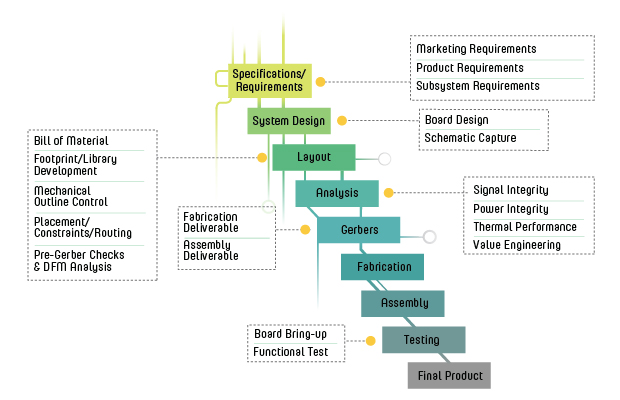
But today better tools, design communities and reuse libraries mean you can find similar products, solutions and reference designs and start with a huge leg up. And, identifying the merging point can also play a critical role in the design process. In hardware design, one of the biggest challenges is the lack of an option to undo the process. It is a process because a sequence of steps is prescribed to produce or change the architecture, and/or a design from that architecture, of a hardware system within a set of constraints. Not all products require a software application to work — think of a Bluetooth speaker. To design it, we basically have to convert your product requirements into code.
Part of our series on fundamentals and education this section covers the most primitive of electronics topics; Topics like voltage, current, and resistance. To turn your idea into a reality you will need a basic understanding of how electrons work. (Skip ahead if you understand things like voltage, and resistance). Once the boards are soldered or the holes drilled, there is pretty much nothing you can do about it. This inability to rework makes the design that much more important.
Hardware designers need to carefully analyze power requirements, select appropriate power supply solutions, and implement power-saving techniques such as voltage regulation, energy harvesting, and sleep modes. The hardware design should be evaluated internally and externally. It is also important to build a feedback cycle into the system as early as possible so that you can make the necessary engineering or component changes. Hardware design is an iterative process that thrives on feedback between engineers and the design team. It is not unusual for a hardware design team to have more than 30 designers with varying specializations. These interdependent teams branch out to work on several smaller elements in the design process and then flow back.
They tend to oversee the full lifecycle of a computer system from concept to installation and maintenance. At the end of the circuit board design stage, we end up with a Gerber File that shows the schematics of the board and a Bill of Materials with the components that will be populated into the board. Most of the time we also deliver one finished, assembled prototype that the customer can now test in its environment before going into production or making changes. This guide covers the first part of the rapid prototyping process — the design phase. You’ll learn about each of the steps involved in designing your hardware prototype so you’ll know exactly what to expect once you begin.




No comments:
Post a Comment